1.Industry Background: Drying Efficiency Bottlenecks in Milk Powder Production
In dairy processing, spray drying is a critical step for converting liquid milk into powder. In practice, manufacturers often face challenges such as low drying efficiency, high energy consumption, and unstable moisture content, which can negatively impact both production capacity and final product quality.
——————————————————————————————————————————————————————————————
2.Key Challenges: How Low Efficiency Impacts Process Stability
-
1) Insufficient evaporation capacity leads to restricted production capacity.
When evaporation efficiency is insufficient, the amount of moisture removed per unit time decreases, directly limiting production throughput especially in continuous processing lines.
-
2) Moisture content fluctuations affect the consistency of powders
Unstable outlet temperature control (typically around 80–90°C) can result in inconsistent moisture content, affecting powder stability and flowability.
-
3) Uneven particle size distribution affects solubility
Poor atomization leads to uneven droplet size distribution, which directly affects solubility and re-dispersion performance.
——————————————————————————————————————————————————————————————
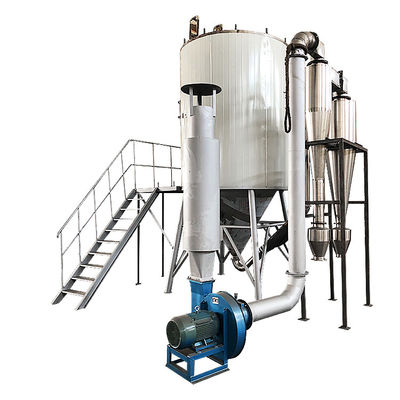
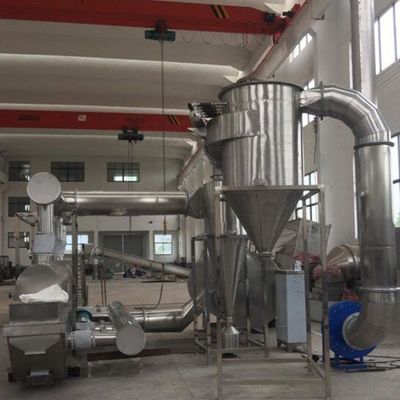
3.Process Solution: Advantages of Centrifugal Spray Drying
-
1)High-speed centrifugal atomization achieves stable particle size control
Centrifugal atomizers operating at 15000–25000 rpm enable uniform droplet formation, ensuring consistent particle size distribution.
-
2) High evaporation efficiency supports industrialized continuous production
With optimized hot air distribution and heat transfer, systems can achieve 95–98% moisture evaporation efficiency, supporting industrial-scale continuous production.
-
3)Temperature control enhances product stability
Inlet air temperatures are typically controlled within 140–350°C, allowing efficient drying while protecting heat-sensitive components.
——————————————————————————————————————————————————————————————
4.Selection Guide: Key Considerations for Milk Powder Processing
When selecting equipment, manufacturers should focus on:
- Evaporation capacity (kg/h) for throughput
- Atomizer speed (rpm) for particle consistency
- Temperature control range (°C) for material compatibility
- Powder collection rate (≥95%) for system stability
——————————————————————————————————————————————————————————————
5.Conclusion: From Efficiency Optimization to Quality Control
For dairy manufacturers, spray drying is not just a piece of equipment but a system involving thermal design, atomization, and process control. By adopting centrifugal spray drying and focusing on key parameters, producers can achieve stable production and consistent product quality without relying on exaggerated performance claims.



 Your message must be between 20-3,000 characters!